Hey Mr. Weatherman

The town I live in is south of Lake Ontario and East of Lake Erie.  These 2 Great Lakes often give us what is called lake effect snow.  In short, the lakes are warm, cold air passes over them picking up moisture and then impolitely dumps it on those of us downwind from the lake.
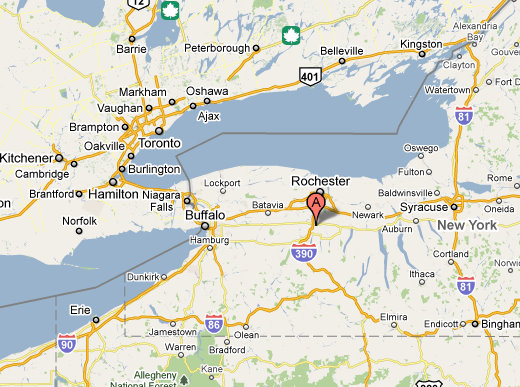
Avon, NY
That's us!

Thankfully the little town I live in is just out of reach of the snows created off each lake.  I like to refer to our weather as the donut effect.  When you watch the weather maps in motion you can see a little donut hole around our town.  We typically miss everything. So, when Mr Weatherman was talking about 4-6” of snow last night with blowing wind (blah blah blah) I totally ignored it.  Why? Let me put it this way.  I’ve plowed 1x all winter yet the City of Rochester just north of me has had over 80+ inches of snow so far this season.
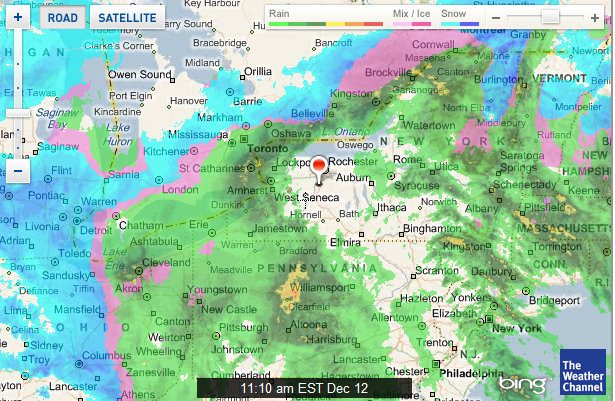
donut_effect_weather
Seriously, this is how our weather usually looks. Our little farm is in a donut hole. From this storm we got NOTHING! Not even rain.

Needless to say when I woke up this morning thinking I had plenty of time for my usual chores list I was in shock to see snow.  Thanks to the wind it wasn’t just 4-6 inches but more like 1-2 feet!  Errrrr!  It’s now 5am and I have to leave in 2 hours to get to work on time. Great.

To complicate my chores even more I didn’t put the new round bale out last night thinking I’d have plenty of time this morning so that was 1st on the to do list; especially since I wanted to test out the new Slow Bale Buddy.  I bundled up, put on my muck boots and bulldozed my way to the workshop.  Of course the blowing snow was a good foot or more up the barn door so I wiggled and pushed and shoveled until I could finally slide the door open. 

Once in, I plugged in the tractor so it could warm up and put the new Slow Bale Buddy in the bucket so I could bring it with me.  I then proceeded to bring in the horses and feed everyone as well as brush off the plow truck and warm it up.

20 minutes later I came back to the tractor and was ready to go get my bale.  Totally forgetting I had the Slow Bale Buddy in the bucket I thought to myself… “self, wouldn’t it be a good idea to use the tractor to clear the snow away from the workshop as I leave?”  Oh yeah, great idea Einstein and I proceeded to clear snow with the tractor. 

It wasn’t until I got to the hay barn that I realized that I just buried my new Slow Bale Buddy under a mountain of snow!  NOOOO!  I went back to look for it but, a new white hay net, in a pile of snow is not easy to find. So I gave up, I guess I’ll just have to use my Bale Buddy again instead.

Hmm. Where is my big green bale buddy?  Oh yeah, buried in the snow somewhere in the pasture. *grumble*  Out I went with the tractor and dug up the bag and dragged it back to the barn for the new bale.  

It turns out maneuvering deep snow in a tractor isn’t as much fun as it seems.  Even with 4×4 the tractor would just slide sidewise or not turn at all.  It was also unnerving when I’d be pushing through the snow in the pasture and then hit a frozen poop pile and get bumped all over especially since I can’t put the roll-bar up.  Mental note, new hay barn needs a minimum of 12’ ceiling, 14’ would be even better.

I finally did manage to complete all my usual morning chores, shovel the walkways, plow the unforgiving long driveway, plow my mom’s driveway, before quickly changing and heading off to work.

As for my test of the Slow Bale Buddy, well, that’ll just have to wait until I find the darn thing in the snow mountain.
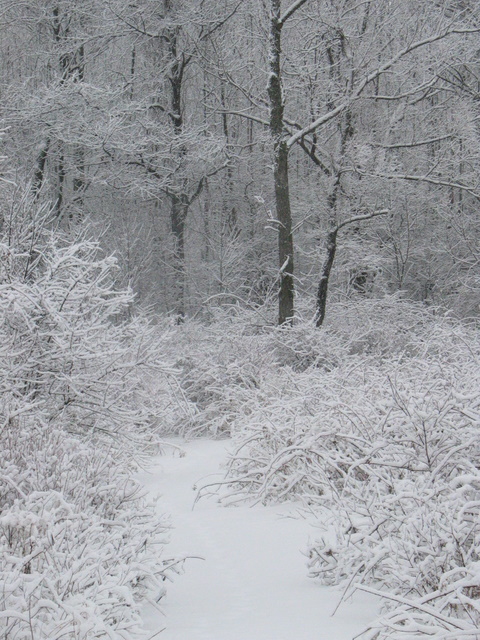
Dutch Hollow Acres Trails

Fiber Arts Friday – Pay It Forward

Welcome back to Fiber Arts Friday.

Unless you’ve been living under a rock you’re probably aware there was a snow event this week.  I know many of you fiber folks were stuck home and were probably enjoying some down time with your spinning and knitting.

Unfortunately for me, I work for a utility and like the post office, wind, rain nor snow will close my office and I am expected to trek in no matter the road closures. Even with moping around at work and wishing I was home I did manage to get some fiber time in.  Since the week was stressful I found my fiber time very relaxing. 

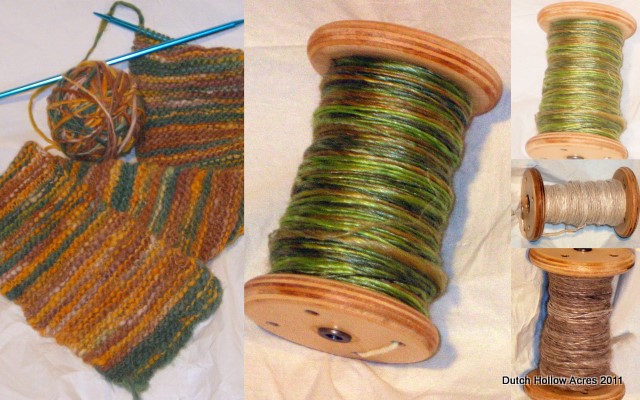
If you follow Wonder Why Gal or myself on Facebook you know that a while back we offered a fiber pay it forward. For the first 5 people that responded to our posts we would hand make an item for them and in return the recipient should make an item for another 5 people.  For me to make items I need yarn so I’ve been working at spinning away.  I have 3 bobbins going all with different yarn. 

Green/Gold – Superwash Merino / Tencel blend – Hope to make a shawl out of this
Gray – Himalayan Cat / Tencel – Yup, I’m still spinning up even more yarn for my friend
Beige – Alpaca / Mystery Wool / Tencel – Not sure what this will be yet

Fiber Pay It Forward

I’m also working on my first ever knitted scarf.  Just something simple but with some of my spun single ply yarn with some fun colors I used to keep it interesting looking. 

I twisted up some cord and braided a custom dog leash for Wonder Why Gal’s miniature schnauzers which I’m hoping they both enjoy.  I also crochet up a little something for her too since she was one of my hand made gift recipients.  Sorry no photos, I don’t want to ruin the surprise!

Photobucket

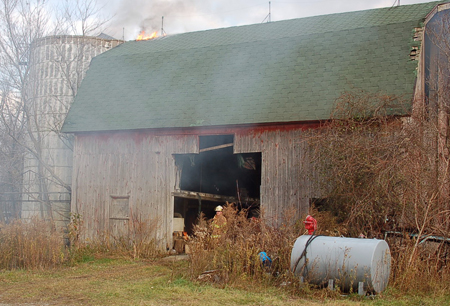
Barn Fire Planning and Prevention

Barn Fire
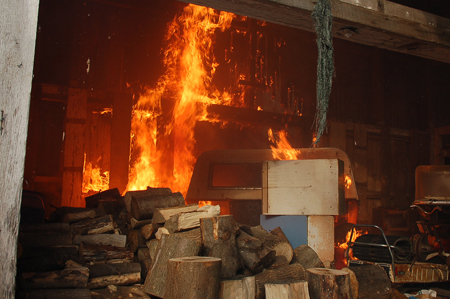
We’ve all seen it in the news or even know someone who had their barn burn down.  Thankfully many times without loss of life to human or livestock but sometimes with disastrous consequences. So what should you do to help prevent fires and how to prep should one happen to you?

Planning:

–       Fire Department – Get to know your fire department.  Stop over and talk with them about what you can do to make your barn fire safe or what you may need to help them do their job better.  For much of the information in this post I interviewed a wonderful Rochester Fire Fighter named …. Elvis.

–       Space – Your little ½ ton pickup and bumper pull trailer can make it down your driveway and maneuver just fine but can a fire truck?  How about multiple fire trucks?  Keep in mind they are pretty big so keep driving lanes and turn arounds clear of vehicles and overhead branches.

–       Water – Always a problem on farms that have wells.  My well tank holds only 100 gallons at a given time and takes about 30 min to refresh.  Way too slow to put out a fire.  Swimming pools and ponds are a good thing to have within a short distance to your barn should you need them.  Another reason for visiting your local fire house is to let them know what your water situation is and to find out if they have pumper trucks or not.

–       Smoke Detectors – when the fireman I interviewed mentioned this ,my reply back was “but my animals don’t know what that means and I can’t hear it from the house.”  He told me that it’s best to put them in any way.  There’s always the potential you can hear it if outside.  The animals may even act up at the sound and if you’re like me (watching from the kitchen window) you know when your animals are not in their normal “happy” state even if they are showing only passive signs.

–       Fire Extinguishers – Keep one by every entrance to your barn and to the feed room.

  • Extinguishers have expiration dates on them.  They typically will last just a few years.  If your extinguisher has expired replace it.  Your old one may still work but you don’t want to find out if it does or not when you need it.
  • Dry CO2 Extinguishers can fail due to inactivity.  Once a month or so take time to beat your extinguisher.  Pound it on the ground or better yet tip it upside-down and beat it with a rubber mallet. This will aggravate the dry contents so they don’t turn into cement on you.

–       Halters and Leads – You should have enough halters and leads that fit every single animal in your barn and on your property.  Keep them tidy and in easy to find areas.  Not only is this good for fires but for any time you may need to evacuate your farm.

–       Lightning Rods – Self explanatory

–       Emergency numbers – Keep them not only in your barn but also in every single other building on your property.  No good having them I the barn if it’s on fire.  My friendly interviewed fire fighter also suggests knowing the local number to your fire house not just 911.  It could mean getting help to you even faster if calling from a cell phone which is forced to use E911.

–       Evacuation Plan – If you manage to get your livestock out the barn where are you going to put them? On my farm animals all have free access to the barn and are never locked in.  Should the barn catch fire I can easily herd animals away from the barn and into the fields keeping them 100ft away from the barn.

Prevention:Barn Fire

–       Clean barn – Keep your barn free of cobwebs and loose hay or straw.  Dust buildup on electrical outlets could cause shorts too.  We all know rodents will eat through electrical wire so keep a cat around to keep those pests out too. Keep weeds and brush away from yoru barn.  Round-up or string trim everything back.

–       Hay storage – ideally you’ll want to store your hay in another building NOT attached to your livestock area.  However, in WNY many barns have lofts so keep these tips in mind:

  • Most hay fires occur within 6 weeks of bailing.  For the first few months of having new hay in your barn check it daily to see if there is any suspicious heat coming from them.  You will know a bad bale when you feel it.  It will be extremely hot to the touch and steam will come out of it if you cut the bale open.  Use caution and don’t burn yourself when removing bad bales.
  • Air flow – It drives me crazy to see hay lofts shut up tight.  Hay needs to breath… keep the loft doors open.  When stacking hay do NOT stack it right up against the wall.  Instead leave it 2-3 feet away from the wall so that air can move around the bales.  Also, stack the bales up on pallets so air can flow underneath.  More airflow = dry hay which will be less likely to ignite on its own.
  • Clean your hay storage area at the end of every season.  Sweep out old hay and dirt before you put the next year’s hay in.

–       Bedding storage – bedding can burn just as easily as hay… Hello wood pellet stoves! Keep only enough bedding in the barn to do that day’s chores.  If you need an extra out-building to store extra bedding/hay/feed pick up a Garage-in-a-box at Tractor Supply.  $250 for a 12x8x20 holds a lot of stuff and will keep it away from your livestock.

–       Mulch – I would have never of thought of this.  Elvis told me a story about how last year he had to put out a fire because the landscape mulch spontaneously combusted.  I guess I’ll be decorating with rocks from now on.

–       Electrical – In an old barn or even a new one there are a lot of electrical issues that can occur.

  • Cleaning – we already covered this but keep your barn clean!
  • Extension cords – They are meant for one time uses not semi-permanent or permanent solutions.  If you find an area where you are constantly running an extension cord for a heated bucket or light then spend the time and $ to put a proper outlet there.
  • Plug Strips – Same goes for plugging multiple things into 1 outlet.  It is nice to have a plug strip but plugging too many things into 1 outlet can overload the wire which in turn heats up, catches a cobweb or hay on fire and poof, your place goes up like a match stick again.
  • Appliances – When possible unplug your appliances such as radios or coffee pots.  If using heated buckets, fans or portable heaters check them frequently.  Don’t let dust build up on fan blades or dirt get worked into the plug of your water bucket.

Fiber Arts Friday – Alpaca Fiber Tensile Strength

My fiber week was spent back to what I like doing the most.  Making ropes for mecate reins, leashes or lead ropes and of course my fiber of choice is alpaca.  But why?

When I got into raising alpacas everyone told me how much better alpaca fiber was for one reason or another and I wanted to do the research and find out if folks were just blowing smoke up my @$$ or not. It turns out there was hardly any research done and I only could find 1 article done by the Yocom-McColl Testing lab, Texas A&M and University of Wyoming entitled “Fiber Characteristics of US Huacaya Alpacas.”

I specifically wanted to learn about fiber strength.  I was not interested in crimp, color, diameter, or any other characteristic unless it directly affected the strength of the fiber.

First and foremost; how is strength calculated and what is is the minimum needed for today’s high speed mill industry?  Strength is calculated in Newtons/kilotex (N/ktex) and is the force measured in Newtons required to break a staple of given thickness measured in kilotex. Mother Earth exerts 9.8 Newtons(1kg x 9.8m/s2) and kilotex is the thickness in terms of mass per unit length (kg/km).

Today’s milling industry requires fiber with a minimum of 30N/ktex tensile strength for processing.

Wool

Wool fiber has a direct correlation between fiber diameter and staple strength.  So much so that Australia research actually has come up with a formula for breeders to follow to improve upon tensile strength.  They can use the CVD (Coefficient Variation Standard Deviation) from fiber reports to improve upon N/ktex.  Breeding for a CVD of 19% or lower creates a stronger wool fiber.  In other words, say your ewe’s mean micron count is 20, breeding to stay within 19% of 20 is ideal for fiber strength. Wool breeders aiming for this CVD, results in producing wool with 30-38 N/ktex.

Huacaya Alpaca Fiber

As it turns out alpaca fiber is extremely strong and has no correlation to color, fiber diameter, or length.  It is naturally strong fiber!  So much so that further studies on its strength aren’t even bothered with because 90% of fiber tested scored higher than the 30N/ktex required for the milling industry.  The mean tensile strength of alpaca is 50N/ktex.  The one study I found back in 1997 for Suri show’s their fiber strength to be 44.4N/ktex. I’m now hearing reports that Suri is stronger than Huacaya due to recent breeding practices but I have not been able to find recent research supporting this claim.

One thing when reading through this study that I did notice, is that alpaca fiber strength seems to increase dramatically with animals raised in the Great Lakes and Northeast regions.  I’m not sure if it’s the cold weather, snow, or forage that the alpaca fiber seems to like, but animals in these regions score and average of 56.25N/ktex.  Alpacas from the central, south and western regions scored an average of 47.26N/ktex.  Fiber Diameter does not appear to affect the strength at all over the regions.

  Great Lakes/North East Central, South and West % difference
Average Strength N/ktex 56.25 47.26 15.98%
Average Diameter µm 29.6 27.9 5.7 %

The study does show that alpaca is also nicer than most wools in that the longer the fiber length does not mean courser fiber.  In fact it tends to be reversed.  The longer the alpaca fiber the finer the micron count and again fiber strength does not appear to be an issue.  Long, fine, short or course alpaca scores above the required 30N/ktex every time. 

I hope I didn’t bore you too much and I guess to sum everything up; alpaca is STRONG!

So what have I been doing with my superior strength alpaca?  Making ropes of course.
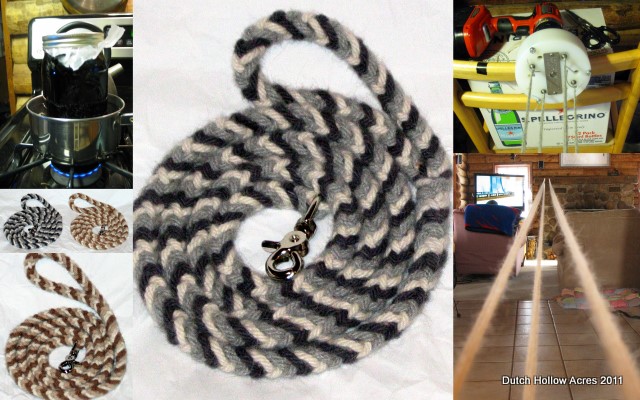
here are some photos of the crazy process I go through to make the 6’ braided dog leashes pictured here.

alpaca cord rope making 
 
 
Shameless Plug… These 2 leashes are available for purchase!
FREE SHIPPING to any Fiber Arts Friday reader who would like to buy one.
Use coupon code:  FAF
 
Note these are big dog leashes… 5/8″ dimeter.  If you’d like a narrower leash I can make one custom for you.

[wp_eStore_fancy3 id=36] 

 I participate in….

Photobucket