Alpaca Business – Writing an Alpaca Business Plan

Most alpaca ranchers are not going to go to a bank and attempt to take out a loan to fund their initial alpaca herds.  So the type of alpaca business plan you’ll probably need is not as in depth as what a bank is looking for.  What I use my business plan for is to keep my spending, marketing, breeding, and sales on tract and I use 1 year, 2 year and 5 year goals in my plan. 

The biggest reason you should have an active business plan is in the off chance you are audited by the IRS.  Many alpaca ranchers run the fine line between running a farm for profit (business) and running a farm at a loss (hobby).  Don’t get me wrong, there is technically nothing wrong with running your farm at a loss and most of you will probably be in the red for 3-5 years after your starting your farm until your herd builds up and you are able to make your first sales. The trick is if the IRS audits you to make sure you are seriously running your farm and attempting to make a profit.  Having a business plan is step one in proving you are running a farm as a business.

Writing a business plan is going to take some time and some homework on your end.  However don’t let it scare you.  In the end you’re technically just interviewing yourself. 

Business Plan Outline – for self use not for banks

  • Purpose
    • Brief description of objectives
  • Description
    • Business Form: DBA, Partnership, LLC, Corporation etc
    • Type of Business: Retail, wholesale, manufacturing, service, etc
    • What is your product/service
    • When does your business open/start?
    • What have you learned from other businesses of similar type?
    • Why will your business be profitable?
    • What are your personal and business goals?
  • Product/Service
    • What are you selling? Seed stock, raw fiber, processed fiber, end products, boarding, shearing, training?
    • What benefits are you selling with your product/service
    • What makes your alpacas, products/services different from other farms?
  • Market
    • Who is your customer? Who will buy from you?
    • Is the alpaca market growing, steady or declining?
    • Is your share growing, steady or declining
    • Are you segmenting your markets? How?
    • Are the markets large enough for you to expand?
  • Competition
    • Write down your closest competitors (alpaca, sheep, goat, fiber farms)
    • Who are your indirect competitors  (Walmart, Joann Fabrics, Local yarn stores)
    • What have you learned about your competition’s advertisements?
  • Product Development
    • What products/services are you considering?
      • Huacaya, Suri, Both
      • Produce high quality seed stock or mid range?
      • Boarding, shearing, sorting, training services?
      • What are you going to do with the fiber?
        • Process yourself, mill, co-op, donate
      • Are you going to sell end products?
        • Made by you? Made in USA? Made in Peru?
      • Where are you selling finished products
        • Online, farm store, farm market, craft fairs
  • Marketing
    • How will you attract buyers?
      • If selling alpacas how will you get your name out to others?
        • Show alpacas, AlpacaNation, OpenHerd, AlpacaStreet, Other?
    • Print advertising? Online? eBay? Etsy? Road Sign?
    • What markets do you plan on entering?
    • How do you price your products/services?
      • Location Location Location!
      • Is your farm easy to get to?
      • How far do people have to travel to visit your farm store?
    • What kind of space do you need?
      • Barns, Pastures, Hay storage, Farm Store
      • How is your land zoned?
      • Do you have parking and wide enough driveway to accommodate traffic for a farm store or for trucks with gooseneck trailers for alpaca transport?
    • Other demographic/market shifts in your area
  • Sales Plan
    • Weekly, Monthly, Quarterly Sales goals
    • What other checkpoints do you have
      • # of cria born per year
      • If you own a stud # of outside breedings sold
      • How many alpacas do you want to board
      • How many head do you want to shear/sort
  • Personnel/Operations/Management
    • I combine these because chances are you are your only employee
    • What is your background/experience? What skills do you have?
    • What are your strengths and weaknesses?
    • What are your plans for training and education?
    • Clearly define your duties
    • What additional resources do you have? (Day job?)

I’ve tried to incorporate many of the alpaca specific questions you would need to ask yourself when writing up your business plan.  Do not expect to answer all of these questions immediately!  I will be going in to many of the headlines over the next few weeks to give you a better idea of how you go about collecting and computing the information needed in your plan. 

Click Here for the Overview and links to other articles

For more personalized help with your business plan stop by your local chamber of commerce, the business department at your local college or university or http://www.sba.gov
Fiber Arts Friday – Flannel Blanket Pattern

Welcome back Fiber Arts Friday visitors!

I finished my mom’s blanket!  It’s already been washed, and is wrapped and waiting for later this month so I can give it to her.  Too bad it’s the start of summer, she might not get to enjoy it until much later since it’s such a thick blanket. 

A friend of mine really liked the blanket and asked for one so that means I actually have to duplicate it!  Yikes.  So, I wrote down the pattern for myself which means I have a pattern to share with all of you!

Country Flannel Blanket Pattern (PDF) – Printer friendly

This blanket is made in strips each strip containing (10) 7×7 inch squares and 6 strips total. Finished blanket size will be 6×4 feet. The strips are made by using 2 strands of yarn at once.  It is a very thick and heavy blanket (6lbs) and it works up very fast.  I crochet slowly and the blanket only took me 15 working hours to finish to give you an idea of how fast it goes.

Materials:
(3) Caron One Pound Yarn – Taupe
(3) Caron One Pound Yarn – Forest Green
Size ‘N’ Hook
Size ‘K’ Hook
Darning needle

Strips 1, 3, & 5

Square 1
Row 1 – Using 2 strands of forest green chain a row of 18 with the N hook
Row 2 – DC in 2nd stitch from hook, DC in each stitch to the end, CH 2 and turn (16) Length should measure 7” add/dec stitches if needed
Row 3-? – DC in each stitch to the end of the row, CH 2 and turn (End your square when it measures 7×7 inches)
Last row of square – do not CH2 and cut a 5″ tail off one of your green yarn
(Note: with the exception of the start of the 1st row of the strip, all of your tails will end on the same side of the strip)

Square 2
Row 1
– tie in taupe yarn leave a tail to darn in later – CH2 – DC in each stitch to end of row, CH2 and turn
Row 2-? – DC in each stitch to the end of the row, CH 2 and turn (End your square when it measures 7×7 inches)
Last row of square – do not CH2 and cut a 5″ tail off one of your taupe yarn

Square 3-10
Repeat Square 2 alternating with 2 green and 1 green 1 taupe until all 10 squares are complete

Strips 2, 4, & 6
Follow same instructions above but alternate using 2 taupe and 1 taupe and one green

Darn all your tails into your work and whip stitch the strips together.  Take care to line up the squares and check as you go.  I had the misfortune of finishing a row and then held it up just miss an alignment half way through the row! Errrr…

Boarder:
Still using the ‘N’ hook but using only 1 strand of green yarn SC all the way around the blanket 2x, Add a SC in each corner so they remain square

Switch to the ‘K’ hook and 1 strand of taupe yarn
Tie your yarn in, Skip a stitch and DC 4x in the next stitch, skip a stitch and repeat 4 DC all the way around the blanket.  This boarder is meant to add a very slight ruffle to the edge and soften up the look of all those squares.

Fiber Arts Friday – Crochet Rag Rug

Welcome Fiber Arts Friday Folks

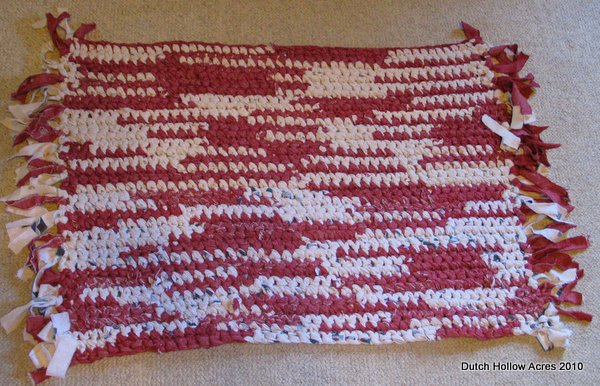
Last week I spent a lot of time cleaning the screen porch and getting all the leaves and dirt out of there that blew in through a hole last fall.  What a mess.  After I got the floor cleaned it looked so bare.  It wanted something, a rug.  I still had some old flannel sheets hanging around so I got to work ripping them into strips.

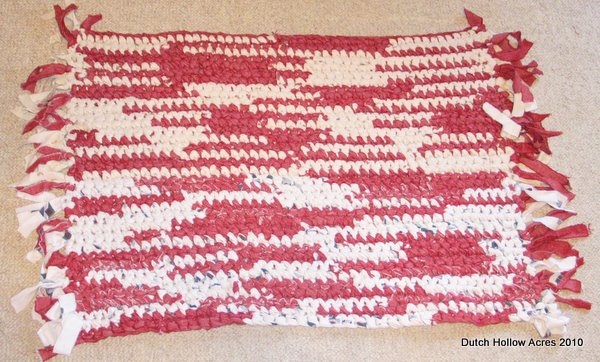
I decided on making a rectangle rug with a random color pattern.  It turns out that was the best choice because I ran out of the beige color!  I ended up replacing it with a more ivory color sheet which at a quick glance you don’t notice but if you look at it hard enough you can see where half the rug has beige and the other half has an ivory look. 

The method I used to connect the strips is exactly the same as the Christmas Rag Rug I made for my brother.  This time I decided not to make the rug the “toothbrush” way but crocheted it instead.  Crochet is faster and makes the rug a bit thicker but doesn’t wear as well as a toothbrush or braided rug.

Directions:

Making Fabric Strips:
For my rug project I decided to repurpose some old flannel sheets.  I cut a little slits along one edge of the sheet every ½ to an  inch or so.  Now comes the fun part!  Grab that little fabric tag and rip!  The flannel sheets tore very evenly right down to the end without the need to cut each strip out by hand.  If you have a cat hanging around this process is very fascinating and you might have to fight for some of your strips back.

How To Connect Fabric Strips:
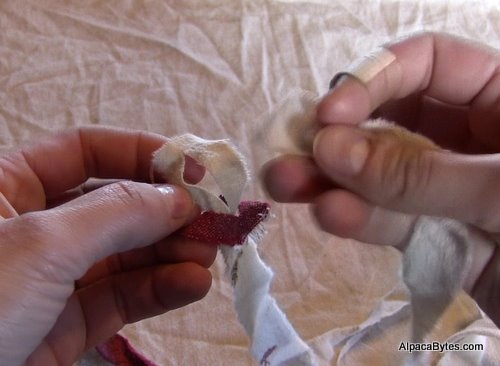
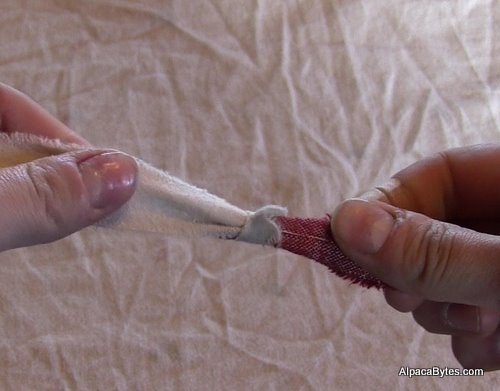
Now that you have all of these strips hanging around you need to be able to put them together.  Many suggestions have you sewing the strips together, which is great, if you have that kind of time to waste.  Easiest method I found is to cut a small slit in the ends of each strip and slipknot them together.  Thread one strip through the slit you made in the other and then feed the tail of the 1st strip through the slit you made in the end.  Pull tight and voila you have connected the 2 strips together.


Hook Size: S-35
Stitch: Single Crochet
Pattern: SC a chain the length you want the rug +1 SC and turn repeat until the width desired is reached.
Color Pattern: I chose to do a random pattern so I connected the strips as I went.
Fringe: Cut fabric strips into 8″ lengths.  Fold in half and feed the fold through the end and slip the tails through the fold and tighten.

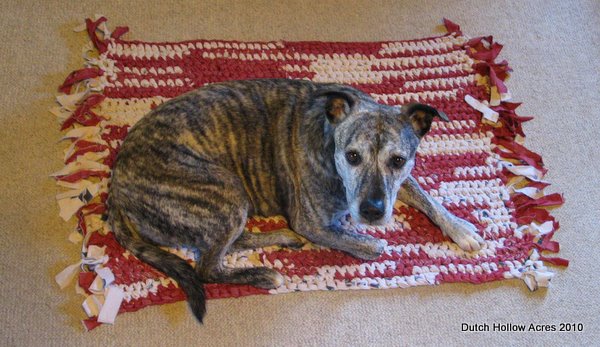
Finished rug size came out to 2ft x 3ft! My dog Brindee has claimed the rug as her own already. *sigh* maybe it’ll end up being a pet rug instead.

Keeping Alpacas Cool

Alpacas are native to elevations of 14,000 feet or more.  Staying warm is their biggest concern hence the luxurious thick warm fleece they grow and we harvest.  In other words they are cold weather animals, not warm.

Here in NY we are having a rather warm weather spell with temps in the 80-90s and high humidity.  Unfortunately, I wasn’t able to schedule my shearer until June 1st which means 3 more weeks of alpacas in full fleece in hot temps!  I can only imagine how miserable they must be. As their caretaker I have to do the best I can to keep them cool.

The best way to keep an alpaca cool is with water.  Hosing down their legs and bellies gives them much reprieve and then they sit in front of the high velocity fans and air out.  One problem for me though, I have a full time job Monday through Friday!  I’m not able to go out every few hours and cool them off, instead I have to find away to hose them off without actually physically being there.

Thankfully alpacas seem to naturally love playing in water.  If anyone sees me dragging a hose around the alpacas come running and line up at the fence for a spray.  The question is, if there’s a hosing station will they come over and spray themselves off and if they do will the dominant ones hog the spot light. There’s only one way to find out, try it.

My solution to the problem was to set up sprinklers on a timer set at chest height so the alpacas could walk through it and cool themselves off.  Here are photos of the products I used thanks to a quick trip to Home Depot.

I “broke” the cheap sprinklers so they didn’t oscillate anymore and set them at a fixed height so the alpacas could get their legs and bellies wet and not their backs.  I have the timer set to 3 minutes of sprinkle time every 4 hours (6am 10am 2pm 6pm).  I’m thinking of upping it to 5 minutes so they have more time to get to it before it turns off.

I was worried that the alpacas A) wouldn’t want to walk into the sprinkler and B) wouldn’t know when it turned on so they could cool off.  My concerns were both unfounded.  The alpacas loved the idea of the sprinklers and the wide range the sprinkler put out allowed even the timid ones to take part.  Also, when the sprinkler turns on the trapped air spits and sputters much like the sound of a garden hose and they all come running.  Actually while I’m writing this the 10am sprinkler just turned on and I just watched all my girls run from grazing out in the pasture to the sprinkler.  It they definitely know it’s on :o)