Alpacas and Taxes


Happy New Year!  Ugh, along with the new year comes taxes.  Before we started our alpaca farm, taxes were a breeze, just plop a few numbers into H&R Bock hit submit and voila my taxes were done.   It’s not so easy any more. *sigh*

With farm business come receipts. Lots and lots of receipts.  Receipts for the feed store, hay, equipment, mileage, chemicals, vet fees, marketing, livestock, professional development, travel, utilities, payroll, fertilizers, fuel, insurance and the list just keeps growing.  Now with it being December 31st my mind should be thinking of champagne and celebrating but instead I’m dreading the lost weekends to mountains of bureaucratic paperwork.  The good news is this is our second year of itemizing all of our deductions so we remembered to save all of our receipts.  Yes it might be a PITA to go through them all but it’s $$$ in your pocket the first few years.  That is until you sell a female alpaca and end up owing the IRS, LOL

Alpaca Tax Tips:

Thinking of starting an alpaca farm?  Start finding old receipts NOW.  When we bought our property 4 years ago it never occurred to us that we might end up having a production farm so we hardly saved any receipts.  Big mistake.  You can deduct farm related items several years prior to you actually becoming a farm.  Examples:  Your property, dwellings, trucks, tractors, equipment, fencing etc.  All useless to you if you can’t find the $%*(@# receipt! 

My advice.  If you have even an inkling of wanting an alpaca farm even 3-5 years into the future start saving your receipts now.  Especially those related to your research of alpacas.  Did you pay for a seminar? Travel Expenses? Mileage?

Get into the habit now of thinking what actually would be considered a tax deduction.  I find myself hording receipts, was that roll of paper towels for the house or the barn? Was the gallon of milk to feed a bottle baby?  Another nice way to think when researching alpacas is the lovely “farm tax exempt” form.  Now when I walk into places like Tractor Supply the prices on the shelf are the actual price because I don’t have to pay sales tax on an item I use for the farm. Not to mention also think along the lines of what tax bracket you’re in.. Are you 10%, 15%, 25% or more? Take that % into account as you will be deducting that on your taxes at the end of the year too.

Fuel Receipts: Gas purchased for vehicles (like tractors) that never leave the farm property are exempt from fuel taxes.  Yeah about ½ of the cost of a gallon of gas is taxes.  $$$ back in your pocket.  Be sure to mark your receipt though, we right TRUCK or TRACTOR on ours so we know if we get to not only deduct the cost of the fuel on our taxes but if we also get the taxes we paid on the fuel back.

The best advice I can give is to get a really good accountant.  Find one who knows agriculture and preferably alpacas.  You will get back on your taxes many times over than what their fees are.

For your viewing pleasure here is a blank copy of the Excel file we give to our accountants.  It is based on the Schedule F form and our accountants really appreciate it.  The more work we are able/willing to do on our end to keep things organized keeps their processing time down and costs low.  

Good luck on your alpaca adventures! 

Disclaimer: I am not nor do I pretend to be an accountant.  Please seek professional guidance elsewhere.

See Our Other Posts!
Starting an Alpaca Farm: New Buyers Guide
Agisting Vs Farm Ownership
Alpaca Care Costs

The Christmas Rug


For those of you who follow me on Twitter I’ve been talking about a Christmas gift I’ve been working on for the past few weeks.  Well with the holiday finally over I’m finally able to indulge all of you with what I’ve been working on; A Rag Rug.

Rag Rugs, also known as Tooth Brush Rugs, Knotted Rugs, or Cottage Rugs are a 100% recycled that anyone and I do mean anyone can make.  If you are like me and have ADHD this project is just for you since you can see results from your labor very quickly. You can also choose to stop at most any time making something as small as a placemat or continue on for large area rugs.

You can use most any linen for these rugs. In the case of this Christmas rug I chose to use old flannel sheets.  Since this was my first rug I did not document the process I used to make it.  I do plan on documenting my next one.  I’ll show you everything from how to make the strips, how to chain them together and the technique needed start and end your rug. 

Until then, please enjoy some photos of the Christmas Rug.  I hope my brother, his wife and most likely their puppy enjoy it thoroughly.


A good starting point for making these is at http://www.ragrugcafe.com/ but found many missing instructions.  She does do a very nice job in her videos showing you the general technique.  I’ll do my best to show you in several future posts how I went about making my rag rug. 

Crochet Kitty Koozie – Cat Bed


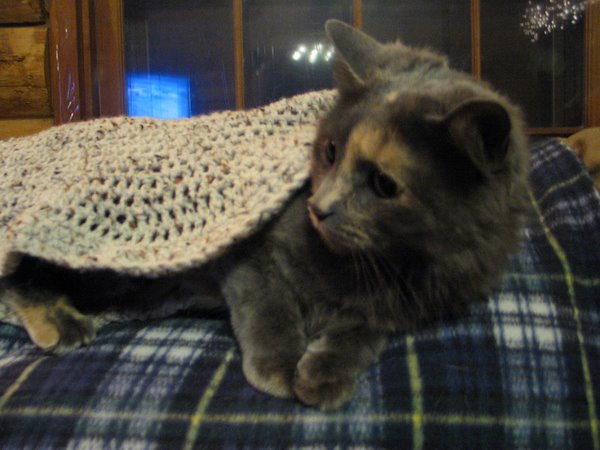
Well we don’t call it a Kitty Koozie to us it’s a Bacon Wrap.  Yes, I named my cat Bacon, I can’t say I’m a cat lover so I named it after something I do love.  Mmmm…. Bacon.

So what is it?   Out of scrap yarn I crocheted little pocket for our Bacon to hide in.  I doubled up on the yarn for the bottom and single crochet a mat so it offers a thick pad.  For the pocket top I switched to single yarn and a double crochet.  This makes the top part light enough that she can dig into it and has stretch so it’ll fit her body snugly. 

The result is a perfect hiding spot for a cold kitty.

Don’t forget to see other Fiber Arts Friday stuff at Alpaca Farm Girl.

BaconWrap

12 Alpaca Days of Christmas

Alpaca_Wreath
On the first day of Christmas
My true love sent to me:
A Long Haired Champion Suri

On the 2nd Day of Christmas
My true love sent to me:
2 Heated Buckets
And a Long Haired Champion Suri

On the 3rd Day of Christmas
My true love sent to me:
3 LGD’s
2 Heated Buckets
And a Long Haired Champion Suri

On the 4th Day of Christmas
My true love sent to me:
4 Tui Grazing
3 LGD’s
2 Heated Buckets
And a Long Haired Champion Suri

On the 5th Day of Christmas
My true love sent to me:
5 Bales of Hay
4 Tui Grazing
3 LGD’s
2 Heated Buckets
And a Long Haired Champion Suri

On the 6th Day of Christmas
My true love sent to me:
6 Macho’s Fighting
5 Bales of Hay
4 Tui Grazing
3 LGD’s
2 Heated Buckets
And a Long Haired Champion Suri

On the 7th Day of Christmas
My true love sent to me:
7 Fans a Blowing
6 Macho’s Fighting
5 Bales of Hay
4 Tui Grazing
3 LGD’s
2 Heated Buckets
And a Long Haired Champion Suri

On the 8th Day of Christmas
My true love sent to me:
8 Cria Pronking
7 Fans a Blowing
6 Macho’s Fighting
5 Bales of Hay
4 Tui Grazing
3 LGD’s
2 Heated Buckets
And a Long Haired Champion Suri

On the 9th Day of Christmas
My true love sent to me:
9 Dam’s a Cushing
8 Cria Pronking
7 Fans a Blowing
6 Macho’s Fighting
5 Bales of Hay
4 Tui Grazing
3 LGD’s
2 Heated Buckets
And a Long Haired Champion Suri

On the 10th Day of Christmas
My true love sent to me:
10 Spinners Spinning
9 Dam’s a Cushing
8 Cria Pronking
7 Fans a Blowing
6 Macho’s Fighting
5 Bales of Hay
4 Tui Grazing
3 LGD’s
2 Heated Buckets
And a Long Haired Champion Suri

On the 11th Day of Christmas
My true love sent to me:
11 Drive By Breedings
10 Spinners Spinning
9 Dam’s a Cushing
8 Cria Pronking
7 Fans a Blowing
6 Macho’s Fighting
5 Bales of Hay
4 Tui Grazing
3 LGD’s
2 Heated Buckets
And a Long Haired Champion Suri

On the 12th Day of Christmas
My true love sent to me:
12 Volunteers
11 Drive By Breedings
10 Spinners Spinning
9 Dam’s a Cushing
8 Cria Pronking
7 Fans a Blowing
6 Macho’s Fighting
5 Bales of Hay
4 Tui Grazing
3 LGD’s
2 Heated Buckets
And a Long Haired Champion Suri


Feeding and Weaning a Bottle Fed Cria

Well I must say that our first experience with birthing and raising a cria has been an exciting one.  I wasn’t expecting to be so involved though.  I thought I’d share with you our hands on 2 month timeline for raising our little Albina. 

There are many different opinions of what to feed cria. Here is the milk cocktail we chose to feed.

2 large spoonfuls of store brand probiotic vanilla yogurt.  Cover yogurt with half/half (~ 3-4oz), fill rest of the bottle with Vitamin D whole milk.  Leave some air in the bottle and shake very well to mix in all the yogurt.  Warm the bottle in a pot of water and it’s ready to serve.  Depending on quantity of milk we chose to feed in a 9oz glass human baby bottle or in a 24oz soda bottle with a flutter lamb nipple.  Cut an ‘X’ in the nipples so that milk flows freely. 

Day 1:
Weight: 20lbs
Albina was able to stand and walk within 40 minutes of birth.  She had a great suck reflex and tried to suckle on the wall.  We checked mom for milk but she was dry.  We repeatedly applied a hot cloth to mom’s belly but no milk dropped.  By hour #2 we decided to mix up some powdered colostrum.   (NOTE:  Learn from our mistake to NOT use powdered colostrums, it does nothing.  Try for fresh cow/goat or frozen llama/goat.)  Baby drank down 24oz of (what we thought was useful) colostrum in 12 hrs. 4oz every 2hrs or so.

Day 2:
We continued to apply hot towels to mom’s belly and finally started to get milk.  YIPPY! Or so we thought.  We pointed baby at mom’s udder but she freaked out, kicked and sat on her baby.  Back to the bottle.  We mixed in the last bit of useless colostrum, with some electrolytes into the above milk cocktail and Albina continued to drink well. 

We took Albina and mom to the vet for a checkup and an IGG and BVD test.  Both came back with a clean bill of health and a 24hr wait for test results from the blood work.

Feeding schedule was 4oz every 2hrs around the clock total of 48oz of milk. Albina drinks bottle without human contact.  We put the bottle in a feeder and she feeds herself.  See Self Feeding Bottle Baby

How much should a cria drink?  10% of body weight to maintain.  15% of body weight to grow.  
15% of 20lbs = 3 pounds = 48oz of milk.  

Day 3:
Feeding still at 4oz every 2hrs around the clock
Weight: dropped to 19.8 lbs

IGG test came back at a ZERO!  Yikes.  Lessoned learned about powdered colostrum. Next time we will be getting fresh cow’s colostrum from the dairy at the end of our road.  Back to the vet we went for a plasma transfusion.

Day 4:
Feeding 4oz every 2hrs around the clock.  Getting very tired.

Day 5:
Feeding 4oz every 2hrs around the clock.  Back to the vet for another IGG test
Weight: 22lbs

Day 6:
Tried feeding in the middle of the night.  Cut out the 2am and 4am feeding… now feeding 6am, 9am, noon, 2pm, 4pm, 6pm, 10pm.  Albina is drinking 7-9oz per feeding now.  IGG Came back at 800!  Yippy!

Week 2:
Still feeding at the Day 6 schedule and she is consistently drinking 8-9oz a feeding all week

Week 3:
New feeding schedule: 6am, 10am, 2pm, 6pm, 10pm She is a piggy and is now consuming 64-70oz a day. We stopped feeding out of 9oz baby bottles and now are using a lamb nipple on a 24oz Mt Dew bottle.

Week 4:
New feeding Schedule: 7am, noon, 5pm, 9pm  Still is consuming 64-70oz a day.

Week 5 & 6:
New feeding schedule: 7am, 3pm, 9pm She is now drinking over 70oz a day

Week 7 & 8
New feeding schedule: 8am & 9pm She’s losing interest in milk all together beginning of week 8 and often refuses the bottle or only drinks 2-4oz.  By now she’s happily eating grass, grain, hay and uses the bottle more for a water supplement than for nourishment.

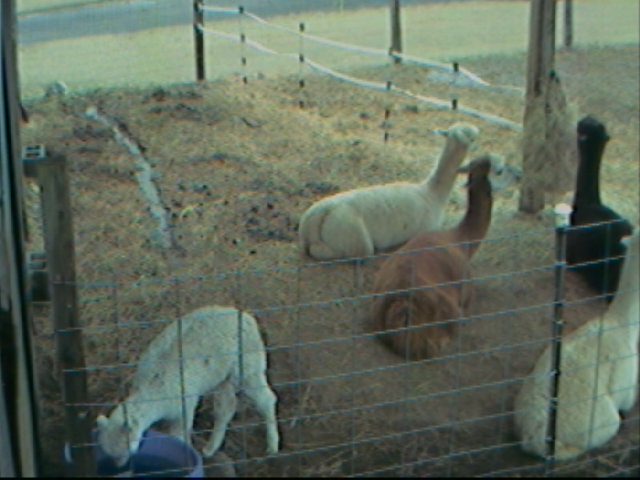
Weaning:  At the end of week 8 she was drinking only 6oz a day maybe.  I made the decision to cut her off fully.  She weighs 52lbs now and is very independent, strong and healthy.  My only concern was her water intake but recent barn cam footage shows she is drinking.  I did consult a vet about weaning at 2 months of age since usually cria will nurse off mom until 6 months or more. They assured me that 2 months is perfectly fine for weaning as long as the cria has a creep feeder with as much hay and grain they want that adults can’t get to.

beaniedrink
Albina drinking water @ 2 months old